Publication
Investigating how quizzes shape problem-solving strategies in elementary programming
Nina Quach, Ahana Ghosh, Man Su, Liina Malva, Danial Hooshyar, Tomohiro Nagashima, and Adish Singla
ISSEP2026 · 2026
@inproceedings{quach2026investigating,
  title     = {Investigating how quizzes shape problem-solving strategies in elementary programming},
  author    = {Nina Quach and Ahana Ghosh and Man Su and Liina Malva and Danial Hooshyar and Tomohiro Nagashima and and Adish Singla},
  booktitle = {ISSEP2026},
  year      = {2026},
}
Abstract
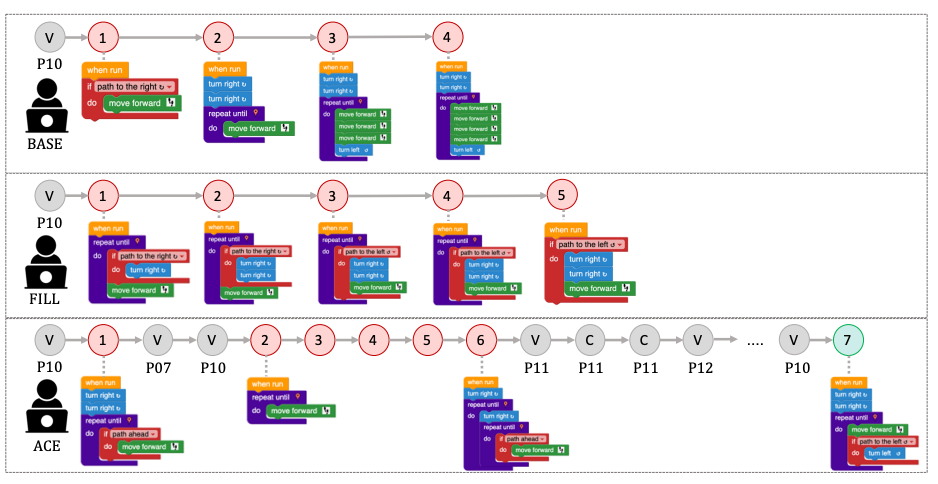
Instructional support is widely used in programming education, yet its effectiveness is typically evaluated using aggregate performance metrics instead of the problem-solving processes it fosters. To examine how instructional support with varying levels of cognitive engagement influences these processes, we study higher- and lower-order instructional support, grounded in Bloom's revised taxonomy and instantiated as quizzes. Specifically, we conduct a mixed-method analysis on classroom study data across three elementary programming curricula: no quiz-based support (BASE), lower-order fill-in-the-gap quizzes (FILL) targeting applying and analyzing levels, and higher-order quizzes (ACE) targeting analyzing, evaluating, and creating levels. Focusing on novel post-learning transfer tasks, we analyze failure and recovery modes, and characterize problem-solving strategies through expert annotation and Affinity Diagramming. Our results show that ACE exhibits higher iterative debugging and stronger transfer outcomes, with qualitative patterns suggesting greater metacognitive engagement. In contrast, FILL shows weaker independent recovery, while BASE supports transfer but risks persistent misconceptions. From a design perspective, these findings suggest combining unscaffolded exploration with targeted higher-order supports to balance independent strategy formation and conceptual accuracy.